TLDR: Your acquisition report is not telling you the whole story.
Sure, pipeline is important and attribution needs to be there so you know where leads are coming from, but there's something more important.
The story goes like this. A founder builds a thing (product or service) that solves a real problem. They do the work, raise capital, bring on serious advisors, and start building a commercial engine beyond their warm network. Early customers come in. Revenue grows. The board is happy. They hire marketing executors, run campaigns, and the funnel fills. Then growth goes flat.
It is not a dramatic fire-drill type problem. Not a crisis. Just engine is just loosing steam... The pipeline looks fine. Marketing is running. But net revenue isn't moving the way it should given the spend. So they call in a valuation firm, hoping to capture the best quarters in the snapshot before the next raise. And then valuation firm spots it: the bucket is filling and then drip drip dripping customers. New customers in. Existing customers leave silently.
This is not a rare story. Uber dominated ride-sharing and didn't see customers leaking to Lyft until riders had already built the habit of opening a different app. VRBO had inventory and brand recognition in vacation rentals while Airbnb was peeling away customers with a superior experience, one booking at a time. Neither company saw the behavior shift of their existing customers. The acquisition funnel was working. The retention signal was buried in TPS reports ;)
For a growth-stage founder, the cost of this pattern is not just revenue. It is learnings lost, valuation, burn rate, runway, and credibility for the next raise.
The question worth asking this month: Do you know, in detail, why your last few customers left? If not, you need to find out.
Blind Spot
The big problem no one is talking about.
|
Learn: The 5 Statements That Stop The Leak and Attract New Customers
This is one marketing mistake that good companies with great products and happy customers make again and again. They invest in acquiring new customers before they can clearly articulate the value their customers receive.
The fix is not a loyalty program. It is not a win-back campaign. It is a clear, defensible Economic Value Story.
McKinsey's Strategy and Pricing framework lists a missing economic value story as a critical flaw. They flag it because it is not just a sales problem. When your customers cannot quickly explain to a colleague why they chose you, when they cannot remember the specific business outcome you delivered, when a competitor shows up with a sharper number and a cleaner story, you are vulnerable. Not because your product got worse. Because your value was never explicit enough to make them stay.
Here is what I have learned from leading marketing strategy across more than 200 companies: your customers do not love your company or your product. They love what your product does for them. A person does not love their contractor after the kitchen remodel is done. They love the beautiful, functional kitchen. A person does not love a SaaS company, they love that systems work together or better. If you are not continuously reminding customers how your product or service improved their life, in numbers and outcomes they can repeat easily, someone else will reframe their investment as a waste of money.
An Economic Value Story is five statements, and they need to live everywhere: your website, your sales materials, your pitch deck, your renewal script. Here are the five statements:
1. Buyer Economic Context. What does their problem cost them, in numbers? Not your opinion of their problem. Their actual spend, scale, and current performance metrics.
2. Cost of Inaction. What does waiting cost them? The dollar figure of staying exactly where they are for another six months.
3. Mechanism. A defensible cause and effect between what you do and how their economics improve. Not features. The chain of events that leads to a better outcome.
4. Financial Translation. The dollar benefit, with the math shown. Founders skip this because the math is hard to pin down. Do it anyway. An estimate grounded in real inputs is more persuasive than a vague promise.
5. Proof. Real results from real customers. Numbers that make the math believable and stories that make the numbers human.
Across the board, companies are missing at least two of these five. If you have all 5, you will win against a competitor every time. If you want to learn how to write these statements, here is a free 6-minute explainer video.
|
|
Build a defensible 5-point Economic Value Story
Short explainer video.
|
NEW RESOURCE
Economic Value Story Builder AI SKILL
Like a shortcut? This is for you. If you have a clearly defined Ideal Customer Profile, but are still struggling to get customers and sales cycles are long, it’s likely you are missing one or more of the five building blocks of an Economic Value Story. This SKILL builds them for you on your favorite LLM.
|
|
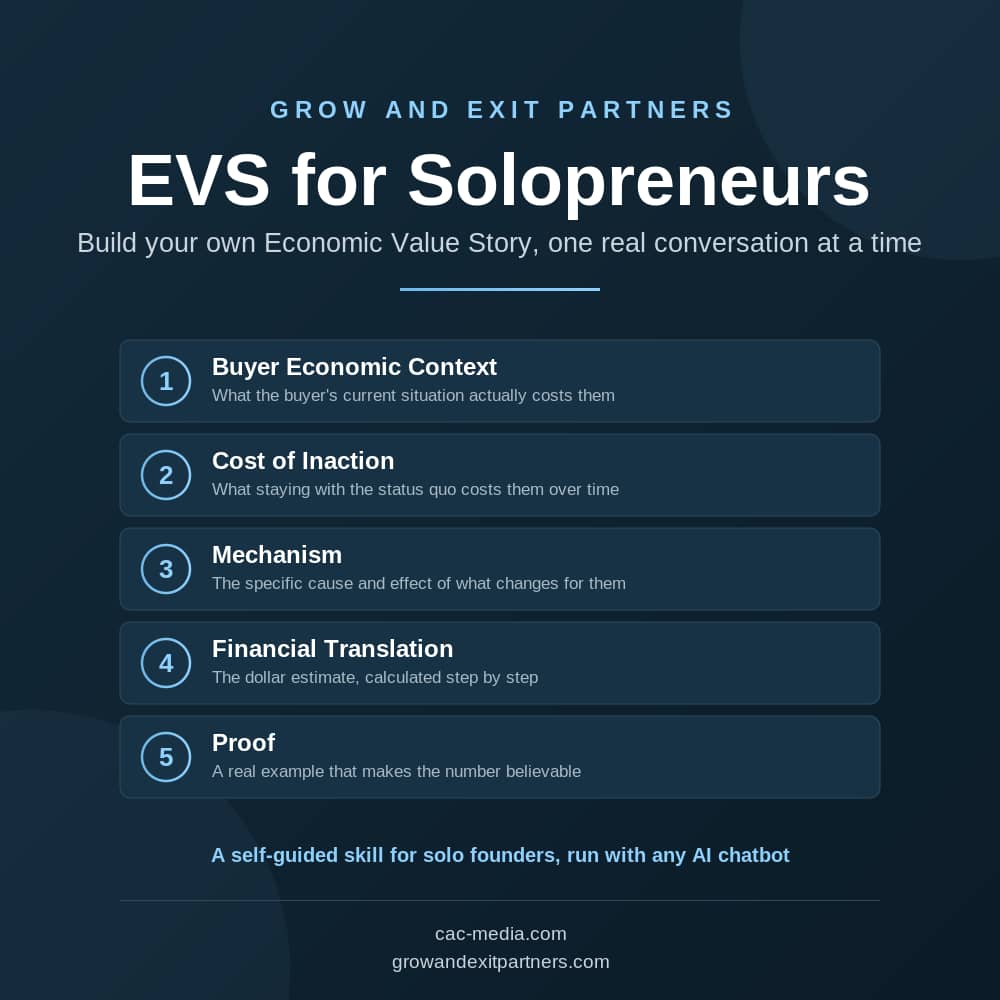 |
Economic Value Story portable AI SKILL
Add the SKILL files to your LLM of choice. Guided interview discovery flow. Interactive, iterative. Revisit the chat in... Read more |
|
Pulse Marketing Moves
What the industry is talking about and how ambitious founders (and the investors that support them) can use the information.
|
73% of sales leaders are now prioritizing growth from existing customers.
A 2025 Gartner survey of 243 Chief Sales Officers found that 73% are prioritizing growth from existing customers over new acquisition, and 57% rank account retention and growth as a top-three priority. Gartner's analysts named the underlying barrier a "customer value gap": organizations struggle to convert their value proposition into outcomes customers can actually feel and point to. This is largely a messaging problem.
What this means for you.
If you are still stealth, ask that cohort of prospective customers you have been courting why they are taking your call. Drill down into THEIR perception of your value. What are they hoping your thing (product or service) will do for them? If it all went well, how much time or money would your thing save them? What's the next best alternative - and how much would they need to spend on that. How would your thing make their job easier, improve outcomes, save resources?
It's easier if you already have customers. Ask them why they purchased and what they have gotten out of it so far. Ask them what feature or improvement would drastically improve the value (bonus: an informed roadmap). They will tell you statements like, "well if your software could do this and that, then I'd be able to get rid of those two other systems I don't like." Your follow up question is, "and how much are you paying for those two software systems right now? And if we could do that for you, how much would you pay for it?" Go into these conversations with an open mind, prepared questions, and be prepared to zip-it and listen.
The clearest messaging wins with both humans and AI agents
A 2026 research report from Pitch Kitchen scoring 200 B2B company homepages on 18 messaging criteria found that companies with the clearest story score 30% higher than their category peers on buyer consideration.
What this means for you
This matters beyond first contact. Buyers who can clearly articulate why they chose you are dramatically more likely to renew, expand, and refer. Clarity is not just an acquisition asset for both AI and humans. It is a retention asset. Suggested action. Get to the heart of your value by drawing a bright line between you and your competitors; this creates a moat both investors and customers can believe in.
or schedule time to talk about your specific challenge.
